
Optimizing Oral Iron Therapy: A Practical Guide for Pharmacists
Supported by an unrestricted grant by Seaford Pharmaceuticals

Among the many questions pharmacists encounter about over-the-counter supplements, one is particularly familiar: “My doctor told me I need an iron supplement, but which one should I take?” It’s a seemingly simple question, yet one that should raise several important clinical considerations. This article provides a practical guide to recognizing iron deficiency and optimizing oral iron therapy through appropriate supplement selection, patient counselling and follow-up in community pharmacy practice.
Iron deficiency is the most common micronutrient deficiency worldwide, and its clinical significance extends well beyond anemia.1 In Canada, risk is particularly high among females of reproductive age and during pregnancy, as well as in children and adolescents during periods of rapid growth. Endurance athletes, regular blood donors and individuals with restrictive dietary patterns are also at increased risk.1,2 Notably, significant disparities exist among Indigenous communities, particularly in infants and young children, where food insecurity and reduced access to traditional iron-rich foods may contribute to deficiency.3
Recognition of iron deficiency has evolved in recent years, including updated Canadian laboratory reference intervals intended to improve identification of iron deficiency.⁴ Although routine population-wide screening is not recommended, targeted identification and assessment of patients with recognized risk factors can help identify those requiring further investigation.1
Beyond Anemia: recognizing iron deficiency
It is well established that iron deficiency can occur with or without the presence of anemia. Non-anemic iron deficiency (NAID) describes depleted iron stores with normal hemoglobin, whereas iron-deficiency anemia (IDA) occurs when iron deficiency is accompanied by hemoglobin below 120 g/L in females or 130 g/L in males. In nonpregnant adults, ferritin <30 µg/L generally indicates iron deficiency regardless of hemoglobin status.2,4
Ferritin is the primary marker of iron stores; however, as an acute-phase reactant, it may be falsely elevated in the presence of inflammation, including infection, autoimmune disease, chronic kidney disease, heart failure or malignancy.1,2 In these patients, fasting iron studies can provide additional context, including transferrin saturation (TSAT), the percentage of transferrin binding sites occupied by iron. In these cases, a TSAT <20% supports iron deficiency despite normal or elevated ferritin. Importantly, iron deficiency in the setting of inflammation should be distinguished from anemia of chronic disease (ACD), in which inflammation restricts iron availability and suppresses erythropoiesis. Pharmacists should also recognize that ACD and IDA may coexist, and this should be considered particularly when the response to iron therapy is inadequate. CBC indices can provide additional clues; however, keep in mind that a normal mean corpuscular volume (MCV) does not exclude IDA. Notably, more than half of nonpregnant females with confirmed IDA in one Canadian study had a normal MCV.2,4
Iron deficiency can cause clinically significant symptoms even in the absence of anemia. Patients with IDA or NAID may experience fatigue, cognitive difficulties, dizziness, cold intolerance, headaches, reduced exercise tolerance, shortness of breath, restless legs, pica, and hair or nail changes, while some may remain asymptomatic.² Recognizing these manifestations can help pharmacists identify patients who may warrant a CBC and serum ferritin levels, either by recommending or ordering laboratory testing where permitted within their scope of practice.
Pharmacists should also recognize that some patients may approach the pharmacy seeking iron supplementation based on a perceived need rather than a confirmed deficiency. Unnecessary supplementation exposes patients to adverse effects and, particularly in conditions associated with iron accumulation, may contribute to iron overload, reinforcing the importance of confirming deficiency before treatment. Microcytic anemia, for example, may also occur with thalassemia or anemia of chronic disease, while other causes of anemia, including vitamin B12 or folate deficiency, should be considered within the broader clinical and laboratory picture.2
In cases of confirmed iron deficiency, however, patients should be treated promptly rather than waiting for anemia to develop.2,4
Why Is the Patient Iron Deficient: causes and risk factors
Identifying the underlying cause of iron deficiency is essential, as supplementation may provide only a temporary solution if the cause remains unaddressed. Common contributors include increased iron loss, increased physiological requirements, inadequate intake and impaired absorption. Chronic blood loss is a frequent cause, particularly in the case of heavy menstrual bleeding in premenopausal females, while gastrointestinal and other sources of blood loss should also be considered.2,4
Inadequate intake may also contribute to deficiency, particularly in the presence of poor nutrition or restrictive dietary patterns, including vegetarian and vegan diets where iron is predominantly obtained from less readily absorbed non-heme sources. Impaired absorption should also be considered in patients with celiac disease, inflammatory bowel disease, previous gastrointestinal surgery or other malabsorptive conditions.1,2
Importantly, iron deficiency or IDA in adult males, postmenopausal females, and premenopausal females without heavy menstrual bleeding is more likely to have a significant underlying cause of blood loss and warrants further investigation, particularly for occult gastrointestinal bleeding or malignancy, rather than supplementation alone.2
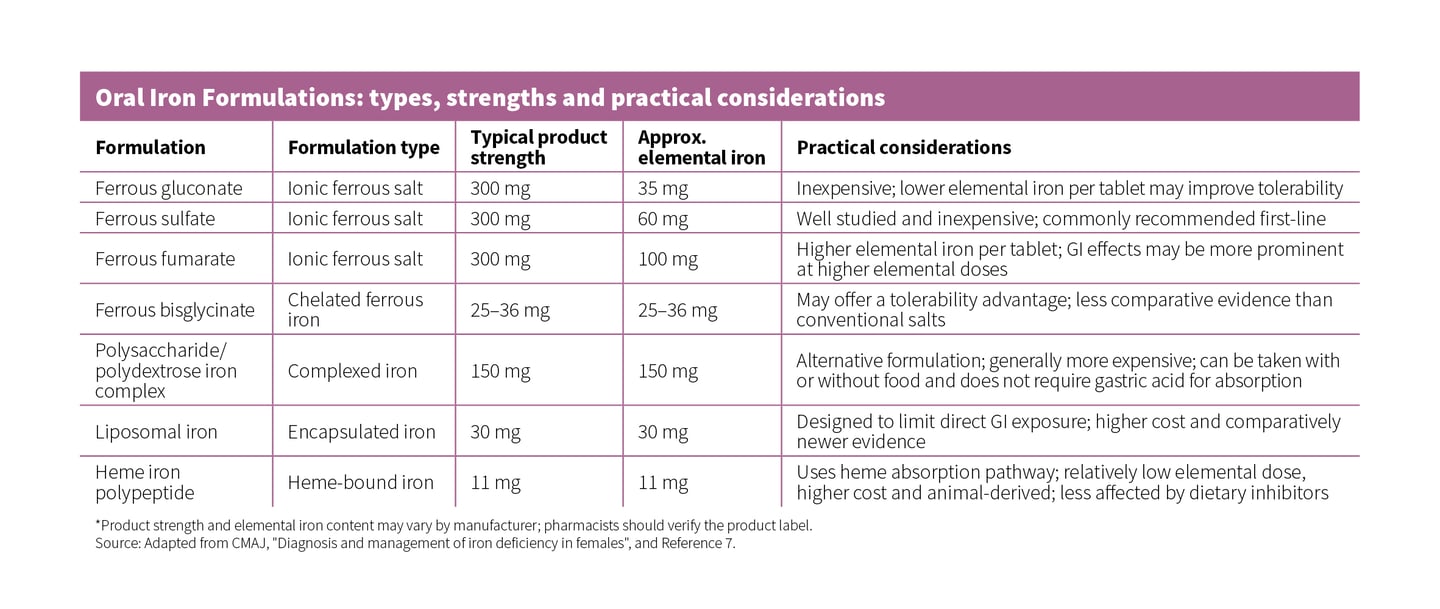
Oral Iron Selection
Research shows that 40.6% of patients may not take oral iron consistently or for the recommended duration, with gastrointestinal adverse effects representing a common barrier to adherence.5,7 Oral iron is generally first-line therapy for NAID and uncomplicated IDA when hemoglobin is >100 g/L, with conventional ferrous salts typically preferred because they are inexpensive, well studied and effective. Patients with hemoglobin <100 g/L warrant further assessment and referral.2,6 Product selection should consider elemental iron content, tolerability, absorption barriers, concurrent medications and likelihood of adherence.7
Adult oral iron dosing is typically individualized within a goal of 100-200 mg of elemental iron daily, based on the degree of deficiency and treatment tolerability.2,7 Conventional ionic formulations, including ferrous sulfate, gluconate and fumarate, release ferrous iron (Fe2+) for absorption via divalent metal transporter-1 (DMT-1) and depend on adequate gastric acidity. Absorption may therefore be reduced by acid-suppressing medications, calcium and foods containing high levels of phytates such as whole grains, legumes, bran, cereals and soy, which bind to iron and reduce its absorption. This is significant as it is the unabsorbed iron in the intestinal lumen that contributes to dose-dependent GI adverse effects, which may reduce tolerability and adherence to treatment.8 Among ionic formulations, ferrous gluconate and ferrous sulfate provide less elemental iron per tablet than ferrous fumarate and may therefore be better tolerated when taken at standard tablet doses.7
Alternative formulations, including polysaccharide or polydextrose iron complexes, heme iron polypeptide and liposomal iron, are less affected by gastric pH, food, calcium and medications, offering practical alternatives for patients taking acid-suppressing therapy or unable to tolerate conventional salts. Although typically more expensive, they may offer tolerability or convenience advantages; however, research has not established superior clinical efficacy with these products over conventional iron salts.6,7,9,10
Ultimately, the most appropriate formulation is one that provides sufficient elemental iron, can be adequately absorbed given the patient’s individual circumstances, and can be taken consistently.2,5,7
Remember, tablet strength ≠ elemental iron: A 300 mg ferrous fumarate tablet, for example, provides approximately 100 mg of elemental iron. Dosing should be based on elemental iron content.2,6,11
Practice Point: Pharmacists should avoid enteric-coated and sustained-release formulations for iron deficiency, as delayed release beyond the primary sites of absorption in the proximal small intestine may reduce bioavailability.2,7,11,16
Oral Iron in Practice: dosing, absorption and interactions
Once-daily oral iron administration is generally preferred over divided doses. Oral iron temporarily increases hepcidin, a liver-derived hormone that reduces both intestinal iron absorption and the release of stored iron into circulation. As hepcidin rises after a dose, absorption of subsequent doses decreases; therefore, more frequent dosing may increase GI adverse effects without proportionately improving absorption. Alternate-day dosing allows hepcidin levels to fall and may increase fractional iron absorption and improve tolerability, making it a useful option when daily dosing is poorly tolerated or in the case of mild deficiency. However, this approach provides less total iron per week and may reduce adherence, so it should not be considered preferable to once-daily dosing.12,13
When determining product selection, a medication review can identify clinically important barriers to iron absorption. Acid-suppressing therapies, including PPIs, H2-receptor antagonists and antacids, can reduce absorption of conventional ionic iron by reducing gastric acidity, while iron can also interact with levothyroxine, tetracycline and fluoroquinolone antibiotics, methyldopa, levodopa and bisphosphonates, largely through the formation of poorly absorbed complexes in the gastrointestinal tract. These interactions should inform counselling and formulation selection, with alternative formulations considered when chronic acid suppression, antacid use or polypharmacy complicates conventional therapy. This may be particularly relevant in older adults, where polypharmacy and multiple absorption barriers can occur simultaneously and compromise treatment response.2,7,14
Pharmacists should also counsel patients to separate conventional iron salts from coffee or tea, calcium or dairy products, and high-phytate foods, which significantly reduce iron absorption.2,7 Chronic heavy alcohol use may also affect iron status through poor nutrition, impaired absorption, or gastrointestinal blood loss. Conversely, acute alcohol may cause increased iron accumulation in susceptible individuals.2,7
Vitamin C (ascorbic acid) enhances absorption of ionic iron by converting Fe3+ to the more readily absorbed Fe2+ form, helping maintain iron solubility and reducing the formation of insoluble iron complexes. However, routine supplementation has not demonstrated improved clinical outcomes when therapeutic doses of iron are used.2,7,8 Notably, it offers no meaningful benefit with non-ionic formulations, whose absorption does not depend on food-related factors or pathways.4,7,1
Patient Counselling: helping patients succeed
Pharmacists should advise patients to take conventional iron salts on an empty stomach (1 hour before or 2 hours after meals), with a full glass of water or fruit juice, preferably earlier in the day when hepcidin levels are lowest to optimize absorption. Starting with a lower elemental iron dose and gradually titrating upward every four to five days may help improve tolerability. If GI effects limit adherence, iron can be taken with a small, non-dairy, low-phytate snack as a reasonable compromise, recognizing that food will reduce absorption by 40%.2,7,11
Setting expectations about adverse effects can also help support adherence. Pharmacists should counsel patients that oral iron salts may cause dose-related nausea, constipation or diarrhea, abdominal discomfort and metallic taste, while darkened stools are expected and harmless. Liquid iron, while allowing for more gradual dose titration, may temporarily stain teeth; however, staining can be minimized by diluting the dose, using a straw and rinsing the mouth with water afterward.2,7,15
When adverse effects still limit adherence, pharmacists can consider reducing the dose, switching formulations or using alternate-day dosing.7,10
Follow-up and Assessing Response
Follow-up is an essential component of iron therapy and should be established when treatment is initiated. When oral iron is well tolerated and the underlying cause is addressed, hemoglobin should begin to improve within weeks. A CBC can generally be reassessed within 2-4 weeks, with an expected hemoglobin increase of approximately 10-20 g/L during this period. An inadequate response should prompt reassessment of adherence, dosing and formulation, drug or food interactions, ongoing blood loss, malabsorption and the original diagnosis, with referral or consideration of IV iron when appropriate.²,⁴
How Long Should Iron be Continued?
Clear guidance on treatment duration is important to prevent premature discontinuation before iron stores are fully replenished. Once anemia has corrected, oral iron should generally be continued for an additional four to six months to replenish iron stores. Ferritin should be reassessed three to six months after hemoglobin normalization in patients with IDA, or three to six months after initiation of iron supplementation in patients with NAID, with a target ferritin >100 µg/L.2 Recurrent iron deficiency warrants investigation and management of the underlying cause rather than repeated supplementation alone.2,7
As healthcare leaders in their communities, pharmacists play a vital clinical role in identifying patients at risk for iron deficiency and helping ensure that treatment is both appropriate and effective. By looking beyond product selection to identify the underlying cause, individualize therapy, address barriers to treatment and ensure appropriate monitoring and follow-up, pharmacists can help patients achieve effective and sustained resolution of iron deficiency.
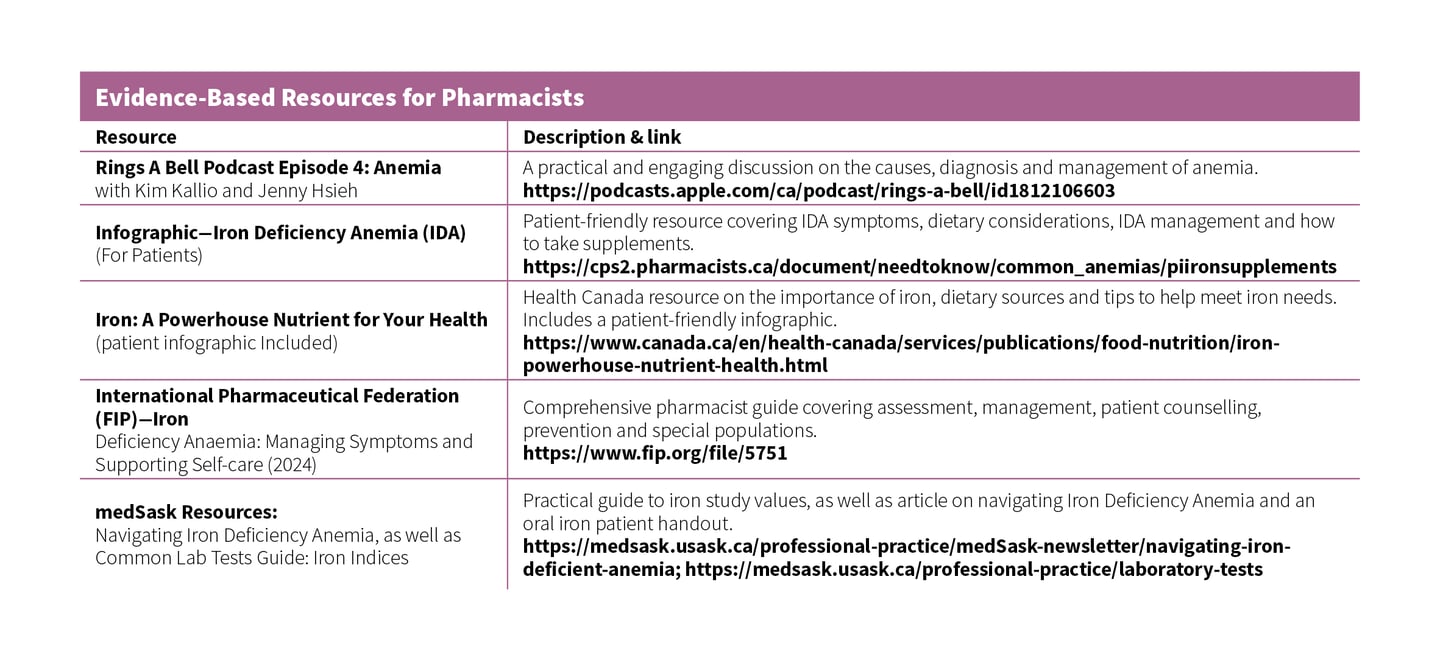
For a closer look at the table, click below.

Lindsay Dixon ([email protected]) is a community pharmacist, pharmacogenetics-certified clinician, science communicator, and co-author of Gut Logic. She is the Public Health Ambassador for Heart Pharmacy Group and founder of the Friendly Pharmacy 5 Podcast.
References:
1. Kolarš B, Mijatović Jovin V, Živanović N, Minaković I, Gvozdenović N, Dickov Kokeza I, Lesjak M. Iron Deficiency and Iron Deficiency Anemia: A Comprehensive Overview of Established and Emerging Concepts. Pharmaceuticals (Basel). 2025 Jul 25;18(8):1104. doi: 10.3390/ph18081104. PMID: 40872496; PMCID: PMC12389209.
2. Guidelines and Protocols Advisory Committee. Iron deficiency – Diagnosis and management [Internet]. 2019. Available from: https://www2.gov.bc.ca/gov/content/health/practitioner-professional-resources/bc-guidelines/iron-deficiency#common-causes%3C/sub%3E%3C/p%3E%3Cp%3E%3Csub%3E3.%3C/sub%3E%3Cspan%3E%3Csub%3E Unger SL, Fenton TR, Jetty R, Critch JN, O’Connor DL. Iron requirements in the first 2 years of life. Paediatr Child Health. 2019;24(8):555–6. doi:10.1093/pch/pxz148.
4. Sholzberg M, Hillis C, Crowther M, Selby R. Diagnosis and management of iron deficiency in females. CMAJ. 2025 Jul 2;197(24):E680–7. doi:10.1503/cmaj.240570
5. Gereklioglu C, Asma S, Korur A, Erdogan F, Kut A. Medication adherence to oral iron therapy in patients with iron deficiency anemia. Pak J Med Sci. 2016 May-Jun;32(3):604-7. doi: 10.12669/pjms.323.9799. PMID: 27375698; PMCID: PMC4928407.
6. Peyrin-Biroulet L, Williet N, Cacoub P. Guidelines on the diagnosis and treatment of iron deficiency across indications: a systematic review. The American Journal of Clinical Nutrition. 2015 Dec;102(6):1585–94. doi:10.3945/ajcn.114.103366
7. Wong V. Optimizing iron deficiency anemia management in community pharmacy [Internet]. eCortex; 2026. CCCEP accreditation no. 1329-2026-4156-I-P. Available from: www.ecortex.ca
8. Pantopoulos K. Oral iron supplementation: new formulations, old questions. Haematologica. 2024;109(9). doi:10.3324/haematol.2024.284967.
9. DeLoughery TG, Jackson CS, Ko CW, Rockey DC. AGA Clinical Practice Update on Management of Iron Deficiency Anemia: Expert Review. Clin Gastroenterol Hepatol. 2024 Aug;22(8):1575-1583. doi: 10.1016/j.cgh.2024.03.046. Epub 2024 Jun 12. PMID: 38864796.
10. Kumar A, Sharma E, Marley A, Samaan MA, Brookes MJ. Iron deficiency anaemia: pathophysiology, assessment, practical management. BMJ Open Gastroenterol. 2022 Jan;9(1):e000759. doi:10.1136/bmjgast-2021-000759
11. Toward Optimized Practice - Alberta Medical Association. Iron Deficiency Anemia (IDA) [Internet]. 2018. Available from: https://www.albertadoctors.org/media/atabokv2/iron-deficiency-anemia-guideline.pdf%3C/sub%3E%3C/p%3E%3Cp%3E%3Csub%3E12.%3C/sub%3E%3Cspan%3E%3Csub%3E Galetti V, Stoffel NU, Sieber C, Zeder C, Moretti D, Zimmermann MB. Threshold ferritin and hepcidin concentrations indicating early iron deficiency in young women based on upregulation of iron absorption. EClinicalMedicine. 2021 Sep;39:101052. doi:10.1016/j.eclinm.2021.101052
13. Stoffel NU, Zeder C, Brittenham GM, Moretti D, Zimmermann MB. Iron absorption from supplements is greater with alternate day than with consecutive day dosing in iron-deficient anemic women. Haematologica. 2020 May;105(5):1232–9. doi:10.3324/haematol.2019.220830
14. Camaschella C. New insights into iron deficiency and iron deficiency anemia. Blood Reviews. 2017 Jul;31(4):225–33. doi:10.1016/j.blre.2017.02.004
15. De-Regil LM, Jefferds MED, Sylvetsky AC, Dowswell T. Intermittent iron supplementation for improving nutrition and development in children under 12 years of age. Cochrane Developmental, Psychosocial and Learning Problems Group, editor. Cochrane Database of Systematic Reviews. 2011 Dec 7;2014(3). doi:10.1002/14651858.CD009085.pub2
16. Malinowski AK, Murji A. Iron deficiency and iron deficiency anemia in pregnancy. CMAJ. 2021;193(29):E1137–8. doi:10.1503/cmaj.210007.