
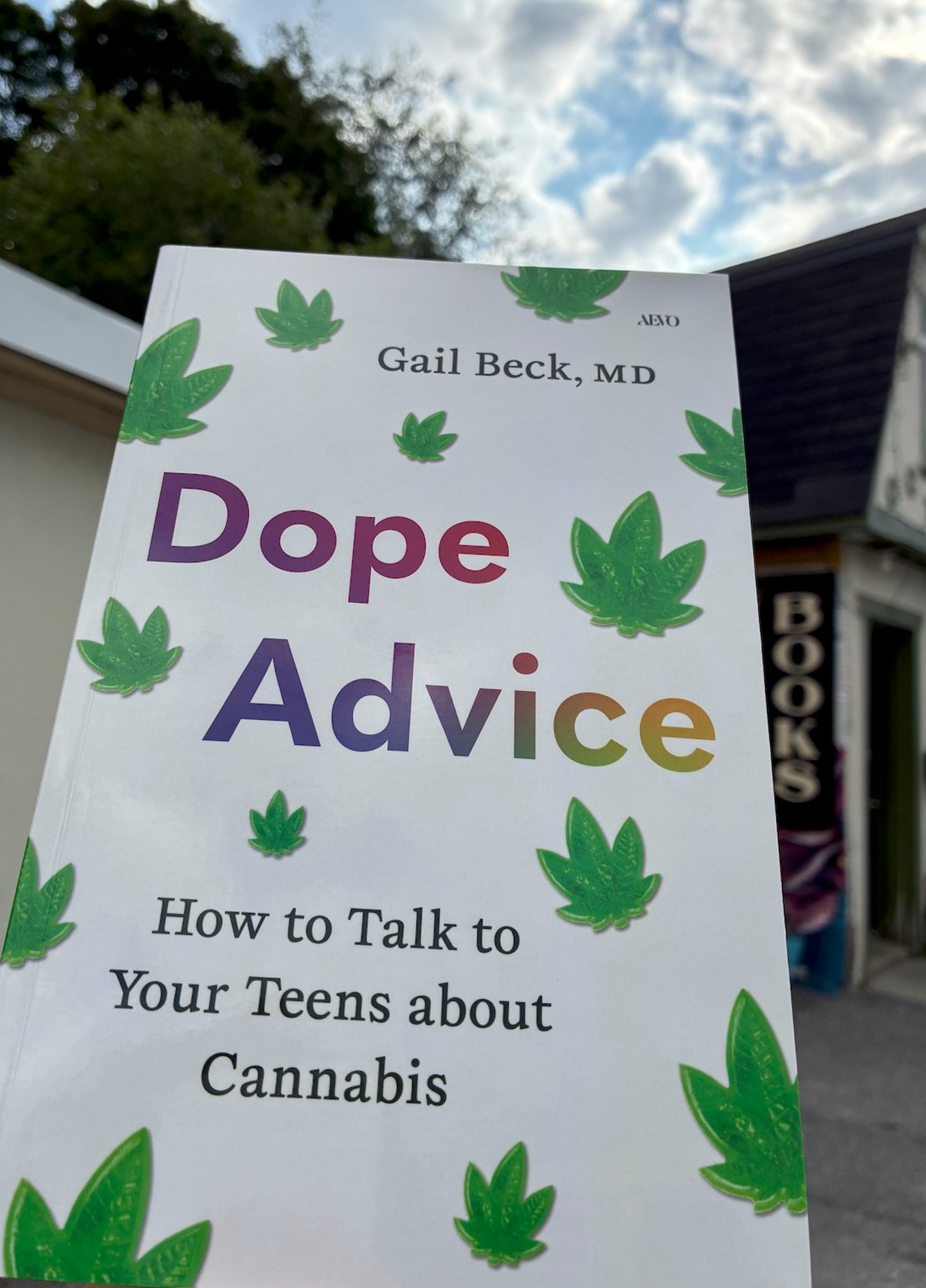
EXCERPT: Dope Advice: How to talk to your teens about cannabis
In two years of giving talks about cannabis, I’ve learned that no one asks their most important questions in public. On a Thursday in April 2017, a bill to legalize cannabis was introduced in the Canadian Parliament. The following Saturday, I was a guest on CBC’s The House, the national broadcaster’s radio program about federal government matters, to talk about how the legalization of cannabis would impact youth mental health. Since that first interview, not a month has gone by when I am not speaking or writing about cannabis and its impact on youth and youth mental health.
At the end of every talk, when the facilitator asks for questions from the audience, there are usually two or three public questions. The first few times I spoke, I felt disappointed that there weren’t more. I hid my disappointment at what I thought was lack of interest as I gathered my papers and shoved them into my briefcase.
After a few public talks, I noticed another pattern. Just when I was ready to leave the room, I would see a dozen people gathered – all ages, all looking around nervously, not catching anyone else’s eye. The first person in line would tentatively move towards me and speak, often in a voice too soft to hear. I would lean forward to catch their question and move away from the line, urging this person to come and sit in the front row and speak with me. I’d say to everyone else, “Just take a seat in line – I’ll make sure you all have a chance to ask your questions.”
Visibly relaxed, everyone would sit down. They’d settle apart from each other, giving themselves space for their own personal worries. I have watched this scenario happen time after time. Most people do not want to ask their questions about cannabis in public. Legal or not, questions about personal cannabis use –or your kid’s cannabis use – still raise eyebrows.
After spending a lot of time listening to the questions people have – the worries they have about their kids’ cannabis use – I realized that this book was necessary. I suspect you’re reading it right now because you have many of the same questions as the parents in the audience.
Your questions and concerns – the questions and concerns of worried parents – are the ones I most want to answer in this book. Like the people in the audience, like the parents in my practice, you want to be well informed about cannabis. You want the knowledge to have honest conversations with your children.
You may also have bought this book because you are an educator or a youth counsellor, with teens in your care coming to you looking for answers to their own cannabis questions. Like parents, you are on the front line, a valued colleague to me and other healthcare providers working to prevent cannabis use disorder and the worst effects of cannabis use. I have thought of you a lot while writing Dope Advice: How to Talk to Your Teens about Cannabis because I wish to be a compassionate, trusted resource for you.
I have provided what clinicians like me understand to be the most up-to-date scientific evidence about cannabis, including all the known risks and possible benefits. I have done my best to write without bias either for or against the legalization of cannabis. I have done this because where I live, in Canada, cannabis is legal, and while it is not legal at the federal level in the United States, it is legal for medicinal use in thirty-five states and for recreational use in twenty-four states. Whether or not we agree, parents, health professionals, and adults working in youth mental health must accept this new reality and work to prevent and treat the illnesses and health problems related to cannabis use. The evidence is overwhelming that, if we want to be effective in the treatment and prevention of cannabis-related illnesses, our approach must be non-judgmental. In my clinical work and with my public audiences, I strive to be non-judgmental. My goal in this book is to be non-judgmental as well. I want to promote a dialogue about cannabis so we can make the best possible decisions as its legal use evolves in North America and around the world.
The integration of legal cannabis into life in North America is not going to be easy. We are still too embarrassed by cannabis use, our own and that of our children, to ask reasonable questions of an expert in public.
Some of the scientific background and information provided is complex and difficult to understand, even for health professionals. This is especially true if you are trying to apply this information to your own child or to a youth you know and want to help. To help you make the transition from dry, scientific information to real life, I will introduce you to four young people and their situations. These young people will be presented as patients. They are, in fact, composites of the hundreds of young people I have known in almost forty years of practising child psychiatry. Mia, Sam, Theo, and Aria will appear in many parts of this book, their stories an illustration of the material being presented. As well as individual work with me, these teens will also appear in a therapy group patterned after a group I hold in the program where I work. Their discussions in this group will provide insight into what teens are saying about mental health and about cannabis use.
You will hear about them as if they were real, and they may resemble people you know, but they are youth conjured in my imagination. As you read about their situations, you will hear some difficult stories. I will discuss suicide, self-harm, and disturbing feelings. This discussion can be distressing, and I urge you, if necessary, to remember that help is available – twenty-four hours per day, seven days per week, every day of the year. Canadians can call or text the 9-8-8 mental health hotline for confidential non-judgmental support at any time.
As well as Mia, Sam, Theo, and Aria, you will meet some of the people in their lives, in particular their parents. I am always encouraged by the resilience and love that parents of the youth in my practice demonstrate. Like the youth, the parents are also composites of all the parents I have met while practising child psychiatry for almost forty years. The content considers situations involving mental health problems, but this material is not only for youth receiving mental health care but for all young people. The conversations included are typical of the kinds of conversations all teens have.
Family situations are often blamed for everything that is going wrong with a child or youth. In mental health and psychiatry, blaming a patient’s parents is as old as Freud. The fears of the parents will likely reflect your own fears. Their questions are the most common questions I hear in my talks and my practice. I address these questions to promote a dialogue between parents and their children, between adults and youth, about cannabis.
We need to have an objective dialogue about cannabis, a discussion that makes it possible to speak about the risks and benefits that accompany cannabis consumption. If we could have this discussion, we might be able to enjoy using cannabis – as we enjoy a glass of wine, or chocolate cake, or any of the other substances and foods we consume that are not really “good” for us but that can enrich our lives.
More importantly, if we could discuss cannabis in a non- judgmental way, we could get a much better grasp on how to prevent its worst effects. We could be partners in keeping youth – and everyone else – safer.
You will also meet my son in this book. He has given permission for me to tell his story. My son’s experience with cannabis and other drugs started when he wanted to manage symptoms of post-traumatic stress disorder, symptoms he developed because of being confined and sexually assaulted as a young boy. He is still living the aftermath of his experiences as well as his experience with our society’s legal response to drugs and drug use, often referred to as the war on drugs.
When the conversations about cannabis began with my own five young adults and my patients, I looked for a reference to help me and couldn’t find one. Dope Advice: How to Talk to Your Teens about Cannabis is the reference I needed, and I hope that the information contained in this book will help you and your family.
This excerpt comes from Dope Advice: How to Talk to Your Teens about Cannabis by Gail Beck, © Gail Beck 2025, published by University of Toronto Press and reprinted by permission of the publisher.